NFPA’s Fire Protection Research Foundation published a report on large-scale fire tests performed at FM Global for rack storage of Group A Plastics under sloped ceilings with slopes steeper than 2 in 12. An excerpt of this report is presented summarizing the results from these suppression tests on ESFR sprinklers with a K-Factor of 16.8. General guidance for sprinkler design is provided by the authors. Read more…
 Based on the recent successful fire test of 50-ft rack storage in single and double row racks with cartoned unexpanded Group A Plastics (and encapsulated/ unencapsulated Class I–IV commodities), FM Global approved a new type of ESFR sprinkler for high-challenge storage applications, the ESFR K-28. It is approved as a ceiling-only, quick-response, wet-pipe, pendent storage sprinkler. Read more…
 Fire code professionals, businesses and building owners are facing the dilemma on how to successfully address fire protection issues when working on distilleries and storage of distilled goods. NFPA Standards and Fire Codes provide only some of the answers. Despite a considerable number of fire tests and subsequent advancements in the fire and building codes, there is still a need to creatively resolve many of the remaining unanswered questions. Read more…
FM Global updated their Data Sheet 8-9 with new high-piled rack storage protection schemes. These new protection options can reduce installation costs by as much as 50%. Large-scale fire tests were used to validate these alternative designs. They demonstrated that large orifice sprinklers and higher flow rates can be successfully applied to not only simplify the sprinkler system but also reduce the total sprinkler water demand. These new protections apply to all commodities including high hazard (plastics) commodities. Read more…
 NFPA’s Fire Protection Research Foundation hosted this year’s conference on suppression and detection in San Antonio, Texas. Presented were the latest research and developments in the fire protection industry that included a diverse cross-section of subjects, such as ‘ESFR K14 sprinklers and High Clearance Update’, ‘Biomass Commodity Classification’, ‘Sub-Scale Analysis of New Large Aircraft Pool Fire-Suppression ‘, ‘Lithium-ion Energy Storage System Fires’ and many more. Read more…
NFPA’s Fire Protection Research Foundation (FPRF) initiated a project to determine the impact of sloped ceilings on the protection of storage with ceiling slopes steeper than 2-in-12 (equivalent to 9.5 degrees). As part of this effort, FM Global was tasked to conduct fire simulations to better understand issues and risks associated with storage under sloped ceilings. The results of these sprinkler activation and suppression analyses have now been released by FM Global. Read more…
NFPA’s Fire Protection Research Foundation (FPRF) initiated a two-phase study on the effects of obstructions on the ESFR sprinkler system’s ability to suppress fires. Phase one, which was primarily a literature review on the topic, was completed in 2014 and the fire test results from the second phase are now published. The tests were performed on Group A Plastics in rack storage configurations protected by K-17 ESFR sprinklers. Read more…
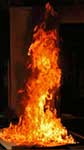 Since the publication of our article on hazards of polyurethane foam fires, the investigation was extended to gather additional insights into PUF’s combustion behavior and associated combustion processes. As it is known, polyurethane foam under fire decomposes into TDI and Polyol. Specifically Polyol combustion processes are investigated in more detail, because Polyol combustion is responsible for the extremely high heat release rates observed during polyurethane foam fires. Read more…
 In-rack sprinklers are used when ceiling sprinkler only protection is no longer adequate to protect the rack stored commodities. Well known disadvantages of current in-rack sprinkler designs are (1) additional costs and (2) additional risks of damage of the sprinkler heads during loading and unloading of the racks. Next generation in-rack sprinklers have been UL-tested that are expected to improve on conditions on both fronts. Read more…
 NFPA made available the education session presentations on their website. These free, downloadable presentation decks (in PDF format) offer an excellent opportunity for anyone looking to continue their education, or who could not attend this year’s NFPA Conference & Expo in Chicago. Audio recordings of the sessions are also available (for a nominal fee), which will help you follow along the presentation slides. Read more…